The Legislature convened the 2008 legislative session on Wednesday, January 9. The session will run for 60-days, as specified in the State Constitution. Ringing in the Session, the Governor gave his State of the State speech that evening in the chamber of the House of Delegates to the members of the Senate, House of Delegates, Justices of the Supreme Court and other dignitaries. During his speech the Governor presented his legislative platform for the Session which focused mostly on economic development and job growth and touched on tax relief and education funding. There were a few mentions of healthcare related topics. He mentioned an initiative to have health screenings for our school age children, and a program to offer free prescription drugs to citizens who can not afford them. The following is an excerpt from the Governor's speech on his healthcare platform:
"...And on a positive note for our children, I am proud to announce tonight the development in our schools of Kids First, a kindergarten health screening program.
Through the use of administrative funds from the State Children's Health Insurance Program, West Virginia will establish a health services initiative that is the first in the nation to ensure every uninsured child entering kindergarten has a wellness screening prior to starting school. A comprehensive wellness screening is an important child development assessment tool and is already covered by PEIA, Medicaid, CHIP and BlueCross BlueShield. By encouraging this early connection to a medical home, we can ensure that children are healthy and ready to learn when school begins, setting the stage for a strong and healthy population down the road. Once this first class of kindergartners is screened, our intentions are to provide follow-up screenings as they reach 2nd, 5th and 8th grades so that we can continue to assess their health as they grow. And I am pleased to say that Mountain State Blue Cross Blue Shield has generously offered to contribute $1.5 million toward the Kids First program. With us here tonight is Fred Early, of Mountain State Blue Cross Blue Shield. Fred, please stand so that we can say thank you.
I am also pleased to announce the formation of WVRx. Beginning Feb. 1, uninsured working West Virginians will be able to access free prescriptions at West Virginia Health Right. Because of a public-private partnership between my office, West Virginia Health Right, Beckley Health Right, the Benedum Foundation, the Heinz Family Philanthropies, the Attorney General's Office and Health-E West Virginia, doctors, hospitals and patients will be able to access prescription drugs donated by manufacturers by phone or e-mail via an efficient, paperless system. ..."
During his State of the State address, Governor Manchin unveiled a wide-ranging plan on what to do with more than $44 million in settlement money awarded to the State Police through the Perdue Pharma OxyContin lawsuit settlement. The funds will be doled out to various entities in the form of grants for various projects. The majority of the funds go to law enforcement in one manner or another; however, $300,000 was awarded to the WV State Medical Association to assist physicians with the purchase of tamper-resistant prescription pads.
As per Federal mandate, all paper prescriptions to Medicaid participants must be written on tamper-resistant prescription pads starting April 1, 2008. The WVSMA has been working to assist our member physicians to make the transition as smooth as possible. The WVSMA will utilize this grant to provide actual tamper-resistant pads to physicians and will provide educational and technical services to physicians to effectuate a smooth transition to these new pads.
Additionally, the governor granted $175,000 to the Bureau for Behavioral Services to provide addiction training programs to healthcare professionals throughout the state. Look for more information on these topics to come from the WVSMA in the coming months.
The Select Committee D on Health and the Legislative Oversight Commission on Health and Human Resources Accountability (LOCHHRA) ended their interim studies with the proposal of a few pieces of legislation to be considered this Session. The following is a summary of the bills:
Establishment of a Maternal Mortality Review Team This bill, proposed by the Perinatal Wellness Partnership, of which WVSMA is a partner, would establish a Maternal Mortality Review Team under the Office of the State Medical Examiner enabling a process to identify and study the causes of maternal deaths. Similar teams have been initiated in other states and are finding many more maternal deaths than initially reported on the death certificates. Many of the deaths might be preventable. The purpose of a Maternal Mortality Review Team is to shed light on these deaths and through identification of the causes possibly help prevent future maternal deaths.
Creation of a Uniform Pregnancy Risk Screening Tool This bill, also proposed by the Perinatal Wellness partnership, would create a uniform maternal risk screening tool to simplify and standardize the process for flagging high-risk pregnancies. The goal is to simplify the process for providers by utilizing the same one page screening tool for all women regardless of the health plan in which the woman is enrolled. It would also enable the collection of uniform data regarding the medical conditions observed most frequently in West Virginia pregnant women to better address care. The specific screening tool would be developed in a rule through the participation of providers and payers.
Establishment of an Office of Oral Health This bill would establish an office of Oral Health under the Bureau for Public Health. The office would coordinate the myriad of issues surrounding poor oral health in WV. The office would provide support to local boards of health and schools, and provide programs addressing oral health education and promotion, and train pediatricians on preventive oral health procedures, among other responsibilities.
Strengthening the Healthy Lifestyles Act This bill modifies the beverages and snacks that may be available for sale in schools and specifies that no soft drinks are allowed for sale and only healthy beverages and snacks. It further defines a healthy beverage to be only "water, 100 percent fruit and vegetable juice with no added sugars, flavored or unflavored non-fat or low-fat milk." It defines healthy or nutritional snacks as "fruits, vegetables, cheese, yogurt, grain foods containing whole grain as the first listed ingredient, nuts and/or seeds." The bill further limits the portions and the calories, fat, trans-fat, and sugar content of the snacks. It is understood that this bill was drafted to mirror the new policy Standards for School Nutrition proposed by the State Board of Education.
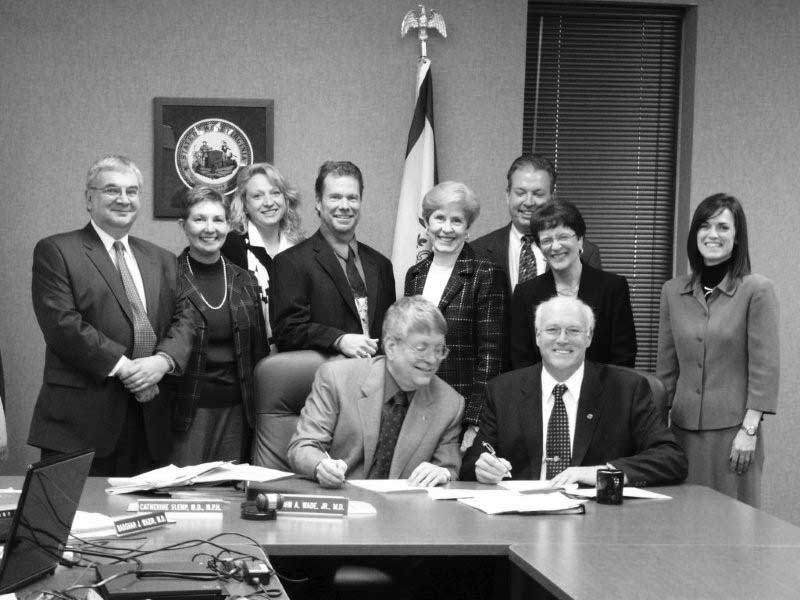
After nearly two and a half years in development, the Board of Medicine has signed an agreement with the West Virginia Medical Professionals Health Program (WVMPHP) to provide monitoring services to licensees with addiction and mental health concerns. The Agreement was signed January, 14 during a regular meeting of the Board. The newly established WVMPHP is fully independent and will provide monitoring and mentoring services to physicians, podiatrists and physician assistants licensed in West Virginia who are impaired due to substance abuse, alcohol abuse or mental health concerns.
Dr. Joseph Selby, immediate past president of the WVSMA, is chair of the WVMPHP Board and Dr. P. Bradley Hall is the Medical Director. The program is housed in the WVSMA office building in Charleston and has already begun providing services to physicians statewide. They are currently in discussions with the Board of Osteopathy to provide the same services to their licensees.
From left to right: Robert Knittle, MS; Renee Green, RN; Marlene Barker; P. Brad Hall, MD; Elizabeth Spangler, MD; Pam Moyers Scott, PA-C; R. Curtis Arnold, DPM and Amy Tolliver. Seated: John Wade, MD and Joseph Selby, MD.
The State Board of Education recently approved a policy modifying the list of approved foods to be sold in schools. This policy was drafted in part to respond to the report issued in April 2007 by the Institute of Medicine (IOM) - Nutrition Standards for Healthy Schools: Leading the Way Toward Healthier Youth. The IOM undertook a study with the Centers for Disease Control and Prevention (CDC) to review and make recommendations about appropriate nutritional standards governing the availability, sale, content and consumption of foods at school, with attention on competitive foods and released the report with their findings.
The Board's policy, number 4321.1 - Standards for School Nutrition, limits the fat, sodium and sugar content in school breakfasts, lunches and snacks. Additionally, it addresses similar nutrition standards for "other" foods and beverages, those typically available in vending machines and concession stands, made available on the school premises during the school day. The policy limits the fat, trans-fat, calories, sugar and sodium content of these foods and eliminates the sale of candy, chewing gum, and flavored ice bars during school hours. At all grade levels, they recommended that no soft drinks be sold and only water, 100% fruit and/or vegetable juice and non-fat and/or 1% low-fat milk, flavored or unflavored be sold, served or distributed during the school day. However, WV Code
VoterVoice