Since the US House of Representatives passed HR 3590 the "Affordable Health Care for America Act" late Sunday evening there has been a loud buzz everywhere you turn from people talking about what is and what's not in the bill. Below is a quick summary of some of the provisions in the bill and the impact on physican practices.
Before the vote the WVSMA shared with our Representatives the resolution on Health System Reform approved by our WVSMA House of Delegates at our mid-winter meeting. You may click here to read a copy of that resolution.
The WVSMA is working hard to boil down the issues into understandable, tangible information for our members. As we get more information we will be sharing it with you and posting it on our website.
As you may know the House passed the bill on Sunday on a vote of 219 to 212, with all the republicans voting no. The House then subsequently passed their reconciliation package 220 to 211. This is bill has now gone to the Senate and negotiations have ensued. Final action is likely to happen by Saturday but it will not likely be smooth with the Republicans gearing up for challenges objecting to provisions that may violate the rule that all reconciliation legislation deal with federal revenue.
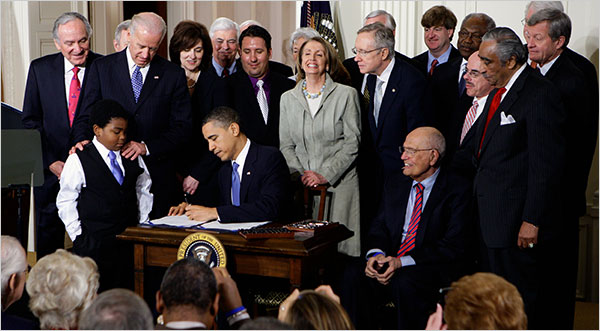
The bill was signed into law by President Obama today in a ceremony at the White House surrounded by Democratic leaders and supporters of reform.
What the Bill Does In a Snapshot
- Health insurance coverage is significantly expanded and competition in the marketplace is improved;
- Pre-existing condition limitations are removed and other health insurance market reforms are implemented;
- Patient-physician relationship is protected;
- Investments and incentives are provided for quality improvement, prevention and wellness initiatives; and
- Insurance claims processing is streamlined and standardized to eliminate unnecessary costs and administrative burdens.
What it Doesn’t Do
- Address a permanent repeal and replacement for the flawed Medicare sustainable growth rate (SGR) formula. 21% impending cut in Medicare payments to physicians scheduled April . Congress and the White House are working on finding a permanent repeal to the SGR and are expected to address this in the coming month.
- Address a big factor in the cost of healthcare - medical liability reform. The legislation establishes a competitive grant program for states to develop, implement and evaluate innovative medical malpractice reforms. This is in addition to the $25 million medical liability reform alternative grant program that the Administration initiated in September 2009, which is being implemented by the Agency for Healthcare Research and Quality (AHRQ).
How the Bill Expands Coverage of Health Insurance
According to the Congressional Budget Office (CBO), the legislation expands coverage to an additional 32 million persons by 2019, equating to coverage of 59 percent of the uninsured. Through:
1. Expanding Medicaid eligibility to all individuals under age 65 (including childless
adults) up to 133 percent of the federal poverty level (FPL),
Federal government will cover 100 percent funding for the expansion
of Medicaid coverage to all individuals from 2014 to 2016, 95 percent in 2017, 94 percent in 2018, 93 percent in 2019, and 90 percent thereafter.
The CBO projects that 16 million uninsured Americans will become covered under Medicaid and the Children’s Health Insurance Program by 2019.
The legislation requires that Medicaid payment rates to primary care physicians providing primary care services be no less than 100 percent of Medicare payment rates for 2013 and 2014, and provides 100 percent federal funding for the incremental costs to states of meeting this requirement.
2. Providing “premium” credits to individuals and families up to 400 percent of FPL ($88,200 per year for a family of four) for the purchase of private health insurance.
3. The legislation also provides dependent coverage for children up to age 26 under all individual and group policies.
Requirement to obtain insurance coverage
Individuals are required to obtain coverage or pay a penalty of a flat tax in the amount of $95 in 2014, $325 in 2015, and $695 in 2016, or as an alternative, as a percent of income in the amount of 1% in 2014, 2% in 2015, and 2.5% in 2016. After 2016, the penalty will increase annually by the cost-of-living adjustment.
Impact on Insurance Company Practices
- Insurance companies are prohibited from denying coverage based on pre-existing conditions
- Premiums may not be based on gender and health status
- Insurers may not drop coverage if policyholders get sick, and once insured, individuals and families will be guaranteed renewal of their health insurance policies
Impact on Insurance Premiums for Insured
- Health insurance premiums will not rise for most people. CBO predicts that premiums in the large group market (nearly 70 percent of the non-elderly covered population) would drop 0 to 3% in 2019.
- Premiums in the small group market (13 percent of those with insurance coverage) may fall—CBO predicts a change from -2% to + 1% compared to current law.
- Premiums in the non-group market (17 percent of those with insurance coverage) are expected to rise. CBO predicts that premiums will increase 10 to 13%. While premiums will likely rise in this market, such policies will contain richer benefits. Additionally 57% of the non-group enrollees will likely receive a subsidy making their actual contribution 56 to 59% lower.
Impact on Physician Practices
Physicians will continue to exercise considerable control over the practice of medicine and the care that they provide to their patients.
The legislation contains a number of provisions that, in combination, clearly benefit physicians and their practices. Recent AMA estimates suggest that physicians provided $24 billion in charity care in 2008, much of it to their uninsured patients.
The financial impact this has on physicians’ practices is particularly acute when private and public payments are declining or flat, and physicians are less able to cover the cost of treating uninsured patients with revenue from insured patients. Expanded health insurance coverage to the uninsured would help with the problem of uncompensated care.
The time and cost burden of physicians’ practices interactions with health plans remains large. Estimates from 2006 suggest that physicians spend three hours per week, their nursing staff spend 19 hours and their administrative staff spend 36 hours per week interacting with health plans. In total, the annual time cost of these activities is more than $68,000 per physician. Many of the administrative simplification provisions in the legislation would reduce these costs.
Troubling Provisions for Physicians
- Value index adjustments to individual physician payments based on cost and quality outcomes by 2015;
- Potential penalties on physicians who do not successfully participate in the Physician Quality
Reporting Initiative (PQRI) by 2015;
- Public reporting of physician claims data to develop performance reports;
- The legislation establishes a target for overall Medicare spending growth and an Independent Payment Advisory Board (IPAB) that would develop proposals to cut Medicare spending if the target rate of growth is exceeded. The Secretary of HHS will be required to implement the IPAB’s proposals unless the statutory process is overridden by new legislation. CBO projects that IPAB cuts would total $13 billion over 10 years; and,
- The legislation bans new physician-owned hospitals and restricts existing facilities, unless they are the primary provider of Medicaid services.
|